This section and the associated Jupyter notebook, DiamondOLG, present a canonical overlapping generations (OLG) model, like the one originally proposed by Diamond (1965), building on Samuelson (1958).[1]
1Setup
The economy has the following features:
Two generations are alive at any point in time, the young (age 1) and old (age 2).
The size of the young generation in period is given by (note that denotes only the young population, not the entire population, and this formula assumes constant population growth since time 0).
Households work only in the first period of life, earning income . They earn no income in the second period of life ().
They consume part of their first-period income and save the rest to finance their consumption when old.
The assets of the young at the end of period are the source of the capital used for aggregate production in period , where is the assets per young household after their consumption in period 1. (For convenience, we assume that there is no depreciation). Note that lower-case letters denote per-capita quantities, a convention used throughout.
The old in period own the entire capital stock and (because they have no bequest motive) will consume it all, so dissaving by the old in period will be (it is because the old in were young in ). The old do receive interest on their capital, so their consumption will be plus the interest income , but the component does not affect saving because it is part of both income and consumption.
Labor and capital markets are perfectly competitive and the aggregate production technology is CRS, (recall that this implies that , which is “Euler’s Theorem”).
2Analysis
Let’s normalize everything by the period- young population , writing normalized variables in lower case. Thus the per-young-capita aggregate production function becomes
The perfect competition assumption implies that wages and net interest rates are equal to the marginal products of labor and capital, respectively:
To make further progress, we need to make specific assumptions about the utility function and the aggregate production function. Assume that utility is CRRA, and assume a Cobb-Douglas aggregate production function .
In this case we can solve for wages and interest rates:
The individual’s maximization problem yields the Euler equation (recall that , an exception to the convention where lower-case does not signify per-capita):
Now let’s assume that utility is logarithmic, . Beginning with consumption in levels and then moving to per-capita, this implies
The steady-state will be the point where . For convenience, define a constant
allowing us to rewrite (5) as
Then the steady-state will be the point where
Dynamics of the model can be analyzed using a simple figure relating the capital stock per capita in period to that in period . The solid locus is a graph of equation (5). We depict the 45 degree line because it indicates the set of “steady-state” points where and thus any intersection of the 45 degree line with the function indicates a steady-state of the model.
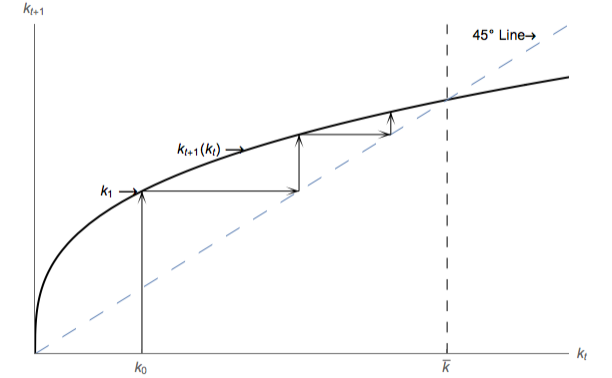
Figure 1:Convergence of OLG Economy to Steady State
The experiment traced out in the figure is as follows. We start the economy in period with capital per capita of , which, from (5), implies a certain value for capital in period . Now think about period 1 becoming and period 2 becoming . To find the correct level of capital implied by the model in period we need to find the point on the 45 degree line that corresponds to , then go vertically up from there to find . When the same set of gyrations is repeated the result is that the level of capital converges to the steady-state level .
3Social Optimum
We have determined the outcome that will arise in a perfectly competitive economy in which households optimally choose their behavior given market prices with no government intervention.
Often in macroeconomic analysis this constellation of assumptions yields a conclusion that the steady state is optimal (and dynamics are also optimal) according to some plausible criteria. We now examine the optimality properties of the OLG model outcome.
As a preliminary, let’s define the lifetime utility experienced by the young generation at time as
Suppose our definition of optimality reflects the choices that would be made by a benevolent social planner who maximizes a social welfare function of the form[2]
subject to the economy’s aggregate resource constraint
where the Hebrew letter reflects the social planner’s discount factor and the planner must allocate the society’s resources (“Sources”) between consumption of the two generations alive at time and the capital stock in period (“Uses”).
The idea is that the social planner cares about every generation’s lifetime happiness, but discounts the happiness of future generations. (We will discuss why discounting is necessary later in the class).
It is possible to show (using methods not described in this section; see Blanchard & Fischer (1989) for details) that the socially optimal steady state is characterized by the equation
In the case of our Cobb-Douglas production function, this becomes
Comparing this to the outcome that will actually arise,
our point is that there is no particular relationship between the socially optimal outcome and the actual equilibrium outcome that will arise if the social planner is not involved. The actual outcome could have too little capital or too much, and there is no reason to expect it to be the “right” amount.
You might respond by saying that our definition of optimality here is too strong; we might hope that the economy would at least be able to avoid a Pareto inefficient outcome, even if we can’t expect perfect optimality according to the preferences of some mythical Godlike “social planner.”
It turns out, however, that even Pareto efficiency is not guaranteed. (In this context, Pareto efficiency must be defined across generations: The economy is Pareto efficient if there is no way to make one generation better off without making another generation worse off).
To examine Pareto efficiency, start by rewriting the aggregate DBC by dividing by the size of the labor force at time :
Define an index of aggregate per capita consumption as
In steady state, , so if is the steady-state level of then the accumulation equation implies
Now consider the effects of a change in on :
There exists a which maximizes per-capita steady-state consumption:
whose solution is obtained from the FOC
and note that this means that for an extra bit of capital actually requires a decline in steady-state consumption. An economy in this circumstance of excessive saving is called “dynamically inefficient.”
Note further that there is actually a so large that consumption would have to be zero:
These points are illustrated graphically in the remaining figure.
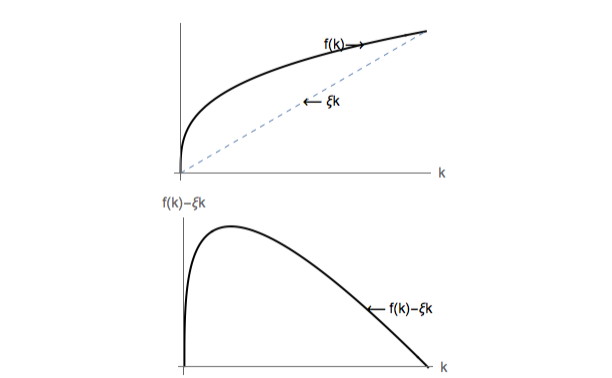
Figure 2:Gross and Net Per Capita Output as a Function of
For a remarkably clear statement of the questions addressed by OLG models, see Jefferson (1789). For a review of the influence of Samuelson (1958)’s model, see Weil (2008).
The multiplying the level of utility for the old generation at time is necessary to prevent the social planner’s problem from exhibiting time inconsistency.
- Diamond, P. A. (1965). National Debt in a Neoclassical Growth Model. American Economic Review, 55(5), 1126–1150.
- Samuelson, P. A. (1958). An Exact Consumption-Loan Model of Interest with or without the Social Contrivance of Money. Journal of Political Economy, 66(6), 467–482. 10.1086/258100
- Blanchard, O., & Fischer, S. (1989). Lectures on Macroeconomics. MIT Press.
- Jefferson, T. (1789). `The Earth Belongs to the Living’: A Letter to James Madison. http://infomotions.com/etexts/literature/american/1700-1799/jefferson-letters-256.htm
- Weil, P. (2008). Overlapping Generations: The First Jubilee. Journal of Economic Perspectives, 22(4), 115–134. 10.1257/jep.22.4.115